

AI-etiquette


The crossed letter
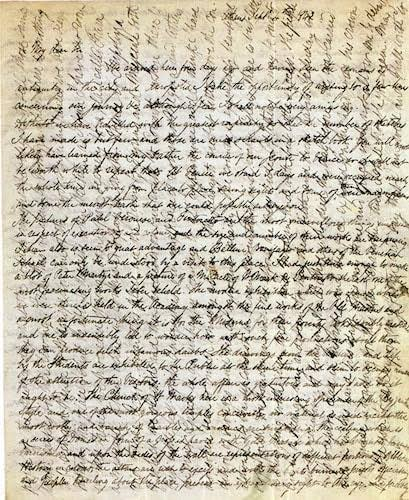
The crossed letter
In 1890, an English gentleman, a certain Charles Dodgson, asked people to please stop crossing their letters, or in other words, to stop rotating the paper ninety degrees to write over what was already written. He requested this in a pamphlet that came inside a stamp case with drawings of Alice in Wonderland on the cover. That gentleman was named Lewis Carroll.
To understand why one must ask for something so extraordinary (that a letter be understood), we have to go back half a century. In England, for a long time, the person who received the letter paid for it. And it was paid per sheet. So you would write the whole page, rotate it ninety degrees, and keep writing over it. And you kept going: you turned the page over, wrote, rotated, and wrote. You tried to be considerate, saving money for the person opening the envelope, and in return, they understood practically nothing of what arrived.
In 1840 came the penny post, a sort of flat rate for letters: you paid by weight, not by sheets, and the sender paid. The gesture of crossing the page no longer saved anything. But people kept crossing letters for decades, and that's why Carroll had to start begging for letters to be legible fifty years later. The custom survived its reason for being, and by outliving it, it did exactly the opposite of what it intended. Everyone, to a greater or lesser extent, has written something illegible.
When I was a teenager—it gives me vertigo to think about that "when"—I used to send rather passionate, slightly cheesy letters to someone I was in love with. But my handwriting was, and still is, practically illegible, and the response "thanks for your letter, but I don't understand anything" became the acknowledgment of receipt. I decided to type them, and then the acknowledgment of receipt changed: "Your letters look like a letter from high school, they have no soul." Nobody had complained about my soul until I tried to fix my handwriting.
The first rule of etiquette invented in a new channel almost always deals with the same thing: who pays the cost of understanding each other. Now we have a new crush, its name is AI, and understanding it is easy; what isn't so easy is understanding each other through it.
Etiquette is an agreement to understand each other
When someone talks about etiquette, we think of arbitrary, outdated, or even classist rules. No one today places their cutlery parallel on the plate so the waiter knows they've finished, nor crosses them to say they haven't yet. That etiquette is nothing more than a code to separate those who know the rules of the game from those who don't.
But there are other kinds of etiquette. For example: when you write an email and you don't write it in all caps, that is etiquette. When you acknowledge receipt of something you won't be able to look at until Thursday, that is also etiquette. Muting the mic when we are in a Meet is etiquette. No one taught us this—but mind you, someone had to think of it—and yet we do it.
The difference between one kind of etiquette and another comes down to one question: who does this rule protect? If it protects the person already inside, it's a mark of belonging and belongs in a museum. If it protects the receiver, it endures for decades and ends up becoming invisible.
Put another way: etiquette is a tacit and unmonitored agreement on how the cost of understanding each other is distributed among those sharing a channel. It doesn't separate what is right from what is wrong; it separates the legible from the illegible, understanding from misunderstanding, conversation from monologue. That's why, viewed from the outside, it seems like an arbitrary whim, and from the inside it's pure economics: someone has to make the effort, and the rule decides who.
The etiquettes that protect those who already know end up in a museum; those that protect the newcomer stay so long that we stop seeing them.
Netiquette wasn't a moment, it was maintenance
In 1994, Virginia Shea published Netiquette and a year later RFC 1855 put in writing how to behave on the net. It is often recounted as a foundational, almost quaint moment: some folks in the nineties explaining that you shouldn't shout. It was something else: engineering for a channel with no face, no body, and no tone of voice. Capital letters are read as shouting because there is no volume. The smiley proposed by Fahlman in 1982 was born to mark a joke, which without a face is indistinguishable from an insult. The ">" symbol appeared so you'd know what they were replying to three days after having written something. Asterisks and underscores were invented to mark the bolding and underlining that the screen didn't know how to render, and today they are Markdown, which is the most brilliant career a rule of courtesy has ever had.
And that didn't end there. We had to rewrite our feedback guide a year ago, being thirty people remote and without any AI involved: how tone sounds asynchronously, the explicit acknowledgment of receipt, keeping emojis out of corrections and chat requests, because what one person puts in to soften, the other reads as passive-aggressive.
Let's pause on what has happened to the emoji. It was born to disambiguate and today, depending on where you put it, it does exactly the opposite: "I need to have the document ready 😉". Just like crossing the page. Etiquette doesn't just expire: it often inverts.
So when AI arrived, we did what we had always done: translate.
Etiquette and AI
At Ideable, and I think we aren't the only ones, a while ago messages started arriving with copy-and-pastes of what a model returned. And we started sending them to each other, because messages don't send themselves. The most common comment in the—virtual—hallways was this: "So-and-so pasted this to me, I don't understand it, I don't want to understand it, they are losing respect for me."
Now they've put a name to this, "slop grenades," the new hit of the summer.
The order of the complaints is important. First, I don't understand. Then I don't want to understand. And ultimately, you are disrespecting me.
We all experience that last one in our daily lives. It's what you feel when you see the poster for the town festival, the menu at the bar downstairs, and the call for a protest with the same vibe, the same golden light, and the same extra fingers. The problem isn't that they are ugly, which they are a little. Nor is it that anyone can make one now, which is good news for anyone who never had someone to make one for them. The problem is that they are all the same.
Against that, we did have an answer, the same as Shea: give ourselves explicit agreements. In July we gave ourselves a good practices guide, and our etiquette came from there:
- No raw pasting in the chat, in Basecamp, in Jira, or in an email. It's not a matter of form: pasting without reviewing reads as disinterest for whoever has to read it.
- The final drafting is signed by you. If something bears your signature, you are responsible.
- And when something goes out unreviewed—which happens, and it's fine that it happens sometimes—it is labeled "AI-Generated - Unreviewed," so the reader can position themselves.
They work. And all three point in the same direction: protecting the receiver. They’re Shea, reinterpreted, and that's completely fine.
And yet, with our etiquette written and being followed, something was still happening that none of them touched.
What isn't seen
Shea's netiquette also had a collective dimension. Don't cross-post, read the FAQ before asking, don't burn up the forum's bandwidth. But it was a dimension of consumption: a common medium existed and the rules prevented you from degrading it, and everything happened within the same channel, in plain sight of everyone.
The collective dimension of AI, however, is one of production. Every conversation with a model, which nobody sees, manufactures structure—criteria, templates, protocols, documents, even knowledge—and that structure adheres to the organization's without having passed through any shared channel. These structures, by the way, can change the culture without us noticing, but that's another conversation.
And it's so easy that it's quite dizzying: an idea is enough to create something new. That sounds lovely, but it can lead to two or more people solving the same problem without any of them knowing what the others are doing.
I had been mulling over for a while how we consume our internal documentation, all that stuff that is written down and that no one finds when they need it. On how I could use AI to turn information into knowledge. I was testing tools, comparing approaches, asking a model which way to go: agents that would read procedures, find contradictions, and talk to whoever asked. I was going to build a contraption that would fix everything.
But one day, in a casual conversation, I found out that this was already in testing and working: a knowledge base connected to the corporate chat, resolving operational doubts with a prompt and an attached document. No one had hidden it from me: I simply hadn't had any conversation where that came up.
How many times is the same problem being solved two, three, or four times on your team, right now, via different paths?
Before, to make progress on something like this, at some point I would have had to ask. And asking does three things: it puts the problem where others can see it, it updates the map of who knows what, and it forces a criterion to emerge from the problem, because a conversation converges. With a model in front of us, we can go—a priori—as far as we want without needing anyone. We gain speed, but we lose everything else.
The risk isn't—just—ending up with two copies of the same thing. It's ending up with two different criteria, both well-founded, neither discussed with anyone. And since each arrives tidy and good-looking, neither is questioned.
This has several problems. Some are obvious: wasted work, the privatization of learning. Another is more subtle, and therefore more dangerous: our company becomes non-deterministic.
You ask how to do something and, depending on who you ask or where you look, you get one answer or its opposite. In software, we call that non-determinism and treat it as a defect, because a system where the same question gives different answers is a system you can't trust. Well, that, but with people. And with the added joke that the tool that caused it—AI—works exactly like that.
There have always been contradictory processes, with or without AI. What changes is the speed at which they appear and, above all, that now they all seem equally good.
Netiquette was a courtesy etiquette, and AI-etiquette has to be, in addition, a coordination etiquette: it is no longer enough to protect the person receiving the message; you have to protect those who aren't yet in the conversation. And for that, we have to care for the channels through which what we decide passes.
Our guide didn't say anything about this: we wrote the rules for the visible problem, just like Shea with the capital letters. That's why we also propose some simple rules so that AI-etiquette encompasses this collective dimension.
- Declare what you are attempting, not just what you conclude. Five open inquiries in parallel are works in progress that no one sees.
- Distinguish what you have generated from what we have agreed upon. It's taking etiquette up a level: from documents to the criteria for generating them.
- And, the most important one, see if someone already had that conversation. And if something useful to others comes out of yours, give it back.
To put this into practice, you don't need sophisticated tools: a document of open problems or a thread to post where you're stuck before you start prompting is enough. And, above all, having spaces for informal conversation with no agenda or minutes. A document doesn't converge; a conversation does. That space serves so someone can say in time: "Hey, wait, so-and-so was working on that exact same thing last week."
None of this can be verified. No one knows what you're exploring on your own if you don't tell them. The only thing that is seen, and late, is the result. But this isn't about policing anyone. Etiquette works when it no longer needs to be remembered, when it's muscle memory and no one could tell you when they learned it.
The letters
Having said all this, the only important thing in this article is what happened with my letters.
What happened is that I kept typing them, because my handwriting had—and has—no fix, but I started adding things on top: capitalized notes, underlines, drawings in the margins, a sticker or two. The capital letters, there, weren't shouts. We hadn't read any of that anywhere, and it wouldn't have been of any use to anyone else.
And it didn't occur to us all at once. We negotiated it letter by letter, and every agreement first cost a misunderstood letter.
Want to know a little more about who wrote this article? 👇
Manuel Cagigas Lago
Trained as a mathematician, I currently work as a Tech Mentor & Advocate at Ideable. I have over 20 years of experience in development, holding various roles: developer, Engineering Manager, CTO, and COO. Lately, I focus on supporting people and, consequently, organizational changes. Some of them even make it to production.